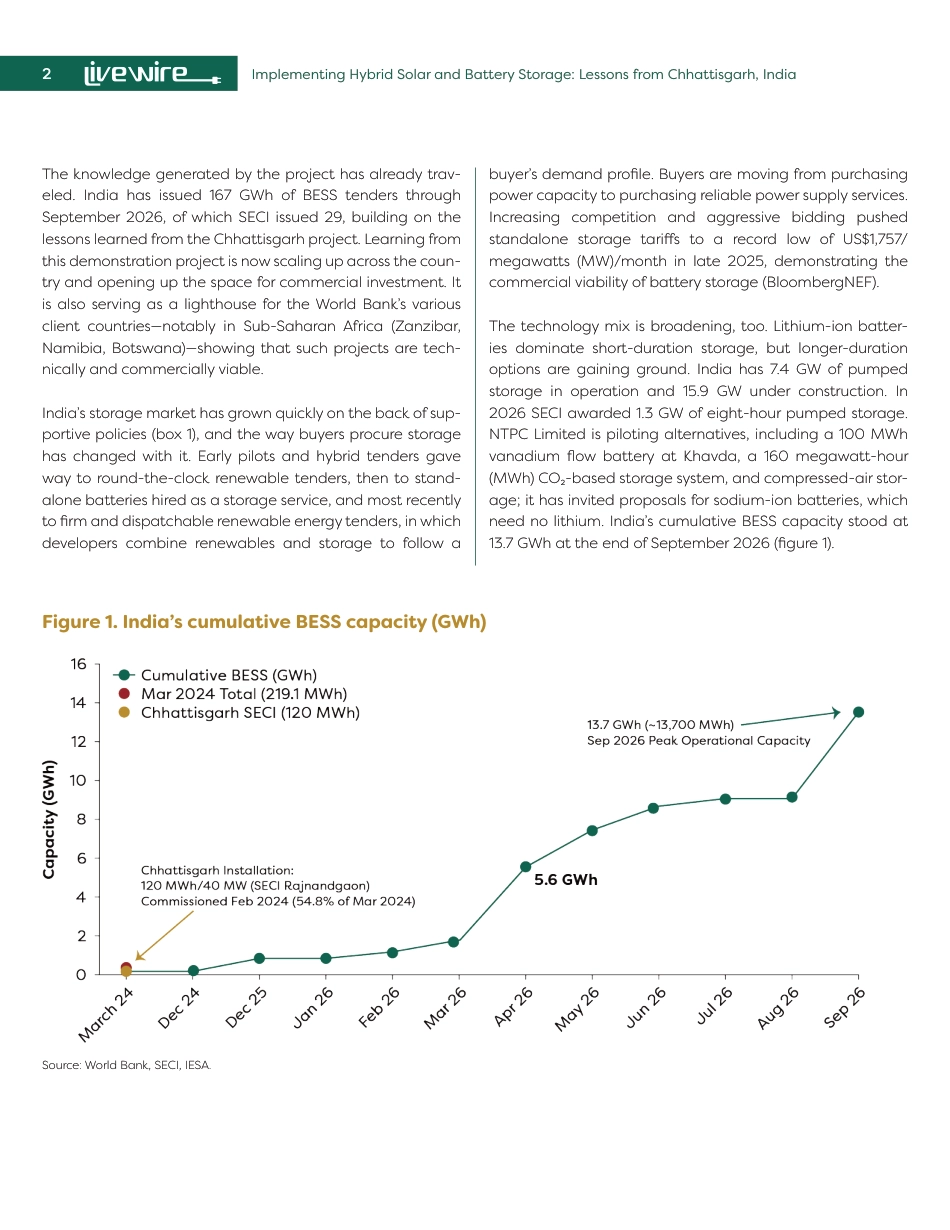
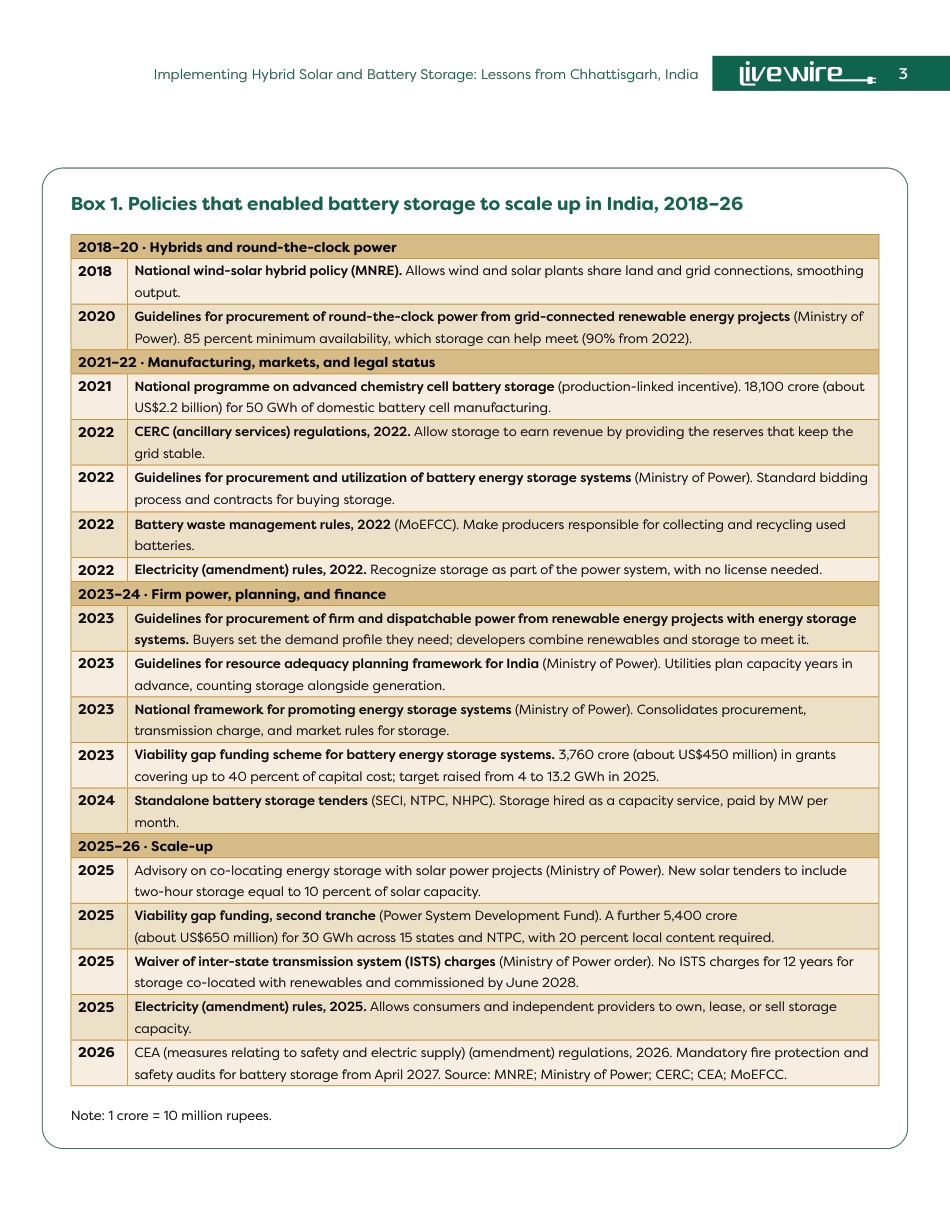
A KNOWLEDGE NOTE SERIES FOR THE ENERGY & EXTRACTIVES GLOBAL PRACTICE2026/155OCTOBER 2026Implementing Hybrid Solar and Battery Storage: Lessons from Chhattisgarh, IndiaAuthorsThe bottom line. India’s solar capacity has grown to more than 171 gigawatts, but the country still faces power shortages during periods of peak power demand, when the sun is not shining. Large battery storage systems can shift daytime solar output into those hours, yet utility-scale storage remains at an early stage in South Asia. With support from the World Bank and the Clean Technology Fund, the Solar Energy Corporation of India Limited built a 100 megawatt solar photovoltaic plant with a 40 megawatt/120 megawatt-hour battery in Rajnandgaon, Chhattisgarh, to meet the state’s evening peak power demand for three hours. This Live Wire discusses some of the key lessons from the project for policy makers, utilities, regulators, and developers. dispatching variable renewable energy when it is needed. Battery energy storage systems (BESS) can store solar energy generated during the daytime hours of power surplus and discharge it during evening peaks. India’s central planner, the Central Electricity Authority (CEA), estimates that the country will need at least 193 gigawatt hours (GWh) of installed BESS capacity by 2031. However, utility-scale BESS deployment remains at an early stage in South Asia.The Chhattisgarh project in India was built to test this model at scale. At the time of commissioning in February 2024, it was India’s largest BESS co-located with solar power (PIB 2024) and accounted for more than half of India’s installed battery capacity (Mercom). It is also the first such project for the World Bank globally and the first large-scale project developed by the Solar Energy Corporation of India Limited (SECI). Its execution prompted several policy and regulatory actions by the government of India.Surbhi Goyal is a senior energy specialist at the World Bank.Why does solar-plus-storage matter for India and other developing countries? Batteries enable solar power meet evening peak demand, but large-scale storage is still new to South Asia India is committed to transitioning to cleaner energy. Installed solar capacity reached 171 gigawatts (GW) by September 30, 2026 (CEA 2026), with growth accelerating sharply after 2021. Yet electricity demand continues to rise during peak evening hours when solar generation is unavailable, result-ing in power deficits. Energy storage is therefore critical to Anita Nabatanzi is an energy specialist at the World Bank.Satyaki Bhattacharya is a senior energy specialist at the World Bank.Public Disclosure AuthorizedPublic Disclosure AuthorizedPublic Disclosure AuthorizedPublic Disclosure AuthorizedImplementing Hybrid Solar and Battery Storage: Lessons from Chhattisgarh, India2The knowledge generated by the project has already trav-eled. India has issued 167 GWh of BESS tenders through September 2026, of which SECI issued 29, building on the lessons learned from the Chhattisgarh project. Learning from this demonstration project is now scaling up across the coun-try and opening up the space for commercial investment. It is also serving as a lighthouse for the World Bank’s various client countries—notably in Sub-Saharan Africa (Zanzibar, Namibia, Botswana)—showing that such projects are tech-nically and commercially viable.India’s storage market has grown quickly on the back of sup-portive policies (box 1), and the way buyers procure storage has changed with it. Early pilots and hybrid tenders gave way to round-the-clock renewable tenders, then to stand-alone batteries hired as a storage service, and most recently to firm and dispatchable renewable energy tenders, in which developers combine renewables and storage to follow a buyer’s demand profile. Buyers are moving from purchasing power capacity to purchasing reliable power supply services. Increasing competition and aggressive bidding pushed standalone storage tariffs to a record low of US$1,757/megawatts (MW)/month in late 2025, demonstrating the commercial viability of battery storage (BloombergNEF). The technology mix is broadening, too. Lithium-ion batter-ies dominate short-duration storage, but longer-duration options are gaining ground. India has 7.4 GW of pumped storage in operation and 15.9 GW under construction. In 2026 SECI awarded 1.3 GW of eight-hour pumped storage. NTPC Limited is piloting alternatives, including a 100 MWh vanadium flow battery at Khavda, a 160 megawatt-hour (MWh) CO₂-based storage system, and compressed-air stor-age; it has invited proposals for sodium-ion batteries, which need no lithium. India’s cumulative BESS capacity stood at 13.7 GWh at the end of September 2026 (figure 1).Figure 1. India’s cumulative BESS capacity (GWh)Source: World Bank, SECI, IESA.Implementing Hybrid Solar and Battery Storage: Lessons from Chhattisgarh, India3Box 1. Policies that enabled battery storage to scale up in India, 2018–262018–20 · Hybrid...