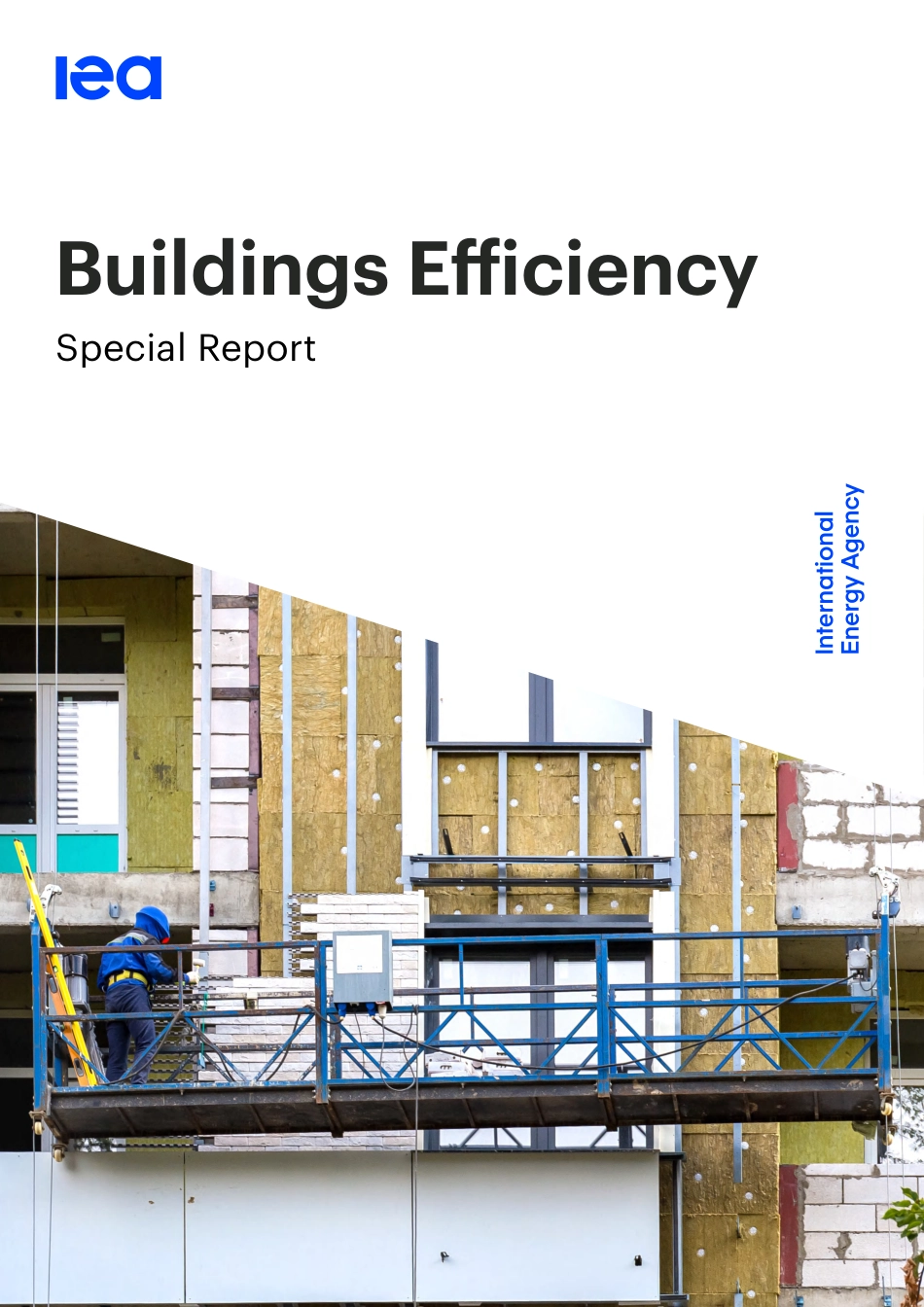
Buildings EfficiencySpecial ReportThe IEA examines the full spectrum of energy issues including oil, gas and coal supply and demand, renewable energy technologies, electricity markets, energy efficiency, access to energy, demand side management and much more. Through its work, the IEA advocates policies that will enhance the reliability, affordability and sustainability of energy in its 32 Member countries, 14 Association countries and beyond.This publication, as well as any data and map included herein, are without prejudice to the status of or sovereignty over any territory, to the delimitation of international frontiers and boundaries and to the name of any territory, city or area.Source: IEA. International Energy Agency Website: www.iea.orgIEA Member countries: AustraliaAustriaBelgiumCanadaCzech Republic DenmarkEstoniaFinlandFranceGermanyGreeceHungaryIrelandItalyJapanKoreaLatviaLithuania Luxembourg Mexico NetherlandsNew Zealand NorwayPolandPortugalSlovak Republic SpainSweden Switzerland Republic of Türkiye United Kingdom United StatesThe European Commission also participates in the work of the IEAIEA Accession countries:ChileColombiaCosta RicaINTERNATIONAL ENERGYAGENCYBrazilIsraelRomaniaIEA Association countries:Argentina ChinaEgyptIndia Indonesia KenyaMoroccoNigeriaSenegal Singapore South Africa Thailand UkraineViet NamSpecial Report on Buildings Efficiency Abstract PAGE | 3 IEA. CC BY 4.0. Abstract This special report developed at the request of Türkiye in the framework of the strategic partnership between the President of COP 31 and the IEA, explores a pathway to improve global buildings energy intensity by at least 25% by 2035. It examines the policies, technologies and investment needed to accelerate progress, assessing policy coverage across building envelopes, electrification of end uses, equipment efficiency and access to clean cooking. The report outlines policy options to support implementation in efforts to reduce emissions, lower energy bills, increase clean cooking access, and manage growing electricity demand. Special Report on Buildings Efficiency Acknowledgements PAGE | 4 IEA. CC BY 4.0. Acknowledgements The report was prepared by the Energy Efficiency and Inclusive Transitions Office (EEIT) in the Directorate of Energy Markets and Security (EMS) and the Directorate of Sustainability, Technology and Outlooks (STO). The report was designed and coordinated by Federico Callioni together with Anthony Vautrin, under the guidance of Stéphanie Bouckaert and Jérôme Bilodeau. Laura Cozzi, Director of STO, and Brian Motherway, Head of EEIT, provided strategic guidance to the report, as did Shinichi Kihara, Director of EMS. Other lead authors of the report were (in alphabetical order): Giulia D'Angiolini, Roland Gladushenko, Bruno Idini, Vincent Jacamon, Haneul Kim, Sofie Kirk, Arthur Roge, Donata Schilling and Fabian Voswinkel. Other contributions were from: Chiara Delmastro, Axel Nordin Furdos, Mine Isik, Chris Matthew and Renee Stephens. Caroline Fedrine provided editorial support. Emily Youers copy-edited the report. Valuable comments were provided by other senior management within the IEA, in particular, Dennis Hesseling, Erica Robin, and Daniel Wetzel. The report would not have been possible without the support of Jethro Mullen, Head of the Communications and Digital Office (CDO), and his team who were responsible for production and launch support, especially Maria Ahmad, Alexia Amado, Poeli Bojorquez, Curtis Brainard, Gaelle Bruneau, Astrid Dumond, Liv Gaunt, Julia Horowitz, Isabelle Nonain-Semelin, Lucile Wall and Wonjik Yang. Peer reviewers Many senior government officials and international experts provided input and reviewed preliminary drafts of the report. Their comments and suggestions were of great value. They include: Yetunde Abdul World Green Building Council Etienne Cadestin Longevity Partners Jorge Chapa Green Building Council of Australia (GBCA) Felix Ciosconara GIZ Antoine Durand Fraunhofer Institute for Systems and Innovation Research Special Report on Buildings Efficiency Acknowledgements PAGE | 5 IEA. CC BY 4.0. Bilal Duzgun Türkiye, Ministry of Energy and Natural Resources Jose Antonio Urteaga Dufour Inter-American Development Bank (IDB) Roland Hunziker World Business Council for Sustainable Development Dominic Keyzer ING Stephen Richardson World Green Building Council Joscha Rosenbusch GIZ H. Namik Sandikci Türkiye, Ministry of Environment, Urbanization and Climate Change Shan Hu Tsinghua University Sanjay Seth The Energy and Resources Institute Julien Tami European Commission Samet Yilanci Türkiye, Ministry of Environment, Urbanization and Climate Change Special Report on Buildings Efficiency Table of contents PAGE | 6 IEA. CC BY 4.0. Table of contents Chapter 1: Introduction ............................................................................................... 7 The importance of buildings’ energy efficiency ..........................................................